Every Marketer Should Be a Growth Factory Builder
Marketing bought the biggest engine in its history and forgot to build the controls. A team that produces more without a closed loop does not stand still. It falls behind, and it falls faster the more it makes.
By Firoz Azees · Published · 27 min read
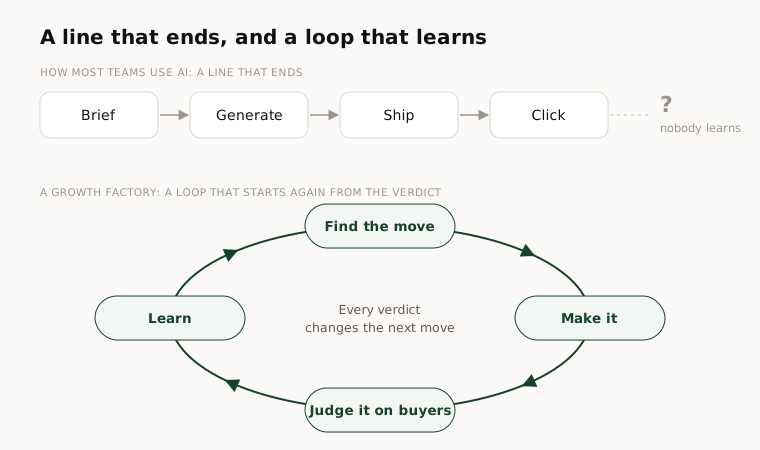
AI-native marketing is a marketing system that learns from every piece it ships: it finds the move worth making, makes it, judges it on what buyers did, and starts the next move from that verdict. Most marketing teams today use AI only to make the piece. A team that makes more without the closed loop learns nothing faster, and falls further behind with every piece it adds.
That is the argument of this paper, written by Firoz Azees for Ivanooo. It is a hard argument, because it says that most of what marketing has done with AI in the last three years has made it busier and worse at the one thing that grows a business.
- Nearly every marketer now uses AI, and the leading use is making content. HubSpot's survey puts text content creation first, at 52% of marketers using generative AI.
- Gartner's 2026 CMO survey found that marketing puts 15.3% of its budget into AI, while only 30% of CMOs say their organisation has the infrastructure to lead with it.
- A team that generates more without judging what worked is running backwards: more pieces, the same number of lessons, and a market that fills with the same average work.
- Every marketer should become a Growth Factory builder: the person who builds the loop that finds, makes, judges and learns. It needs no code. It needs direction, macro and micro.
What did the Wright brothers have that Langley did not?
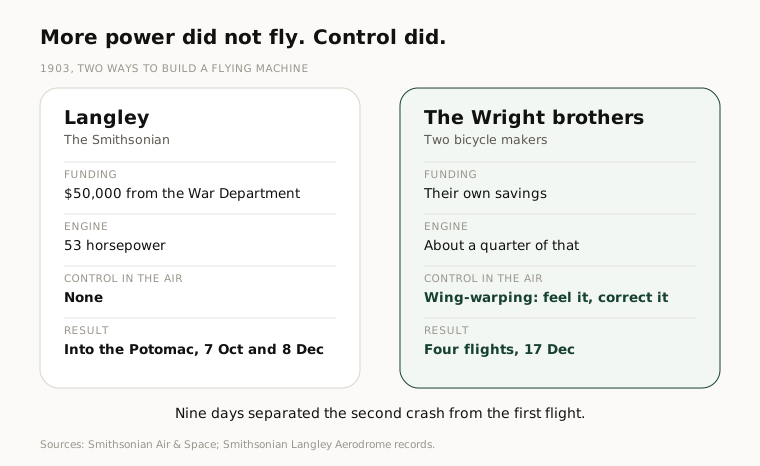
The Wright brothers had control, and Samuel Langley had power. In 1903 Langley ran the Smithsonian Institution. The War Department gave him $50,000 to build a flying machine. His engine produced 53 horsepower, about four times the engine the Wrights built for themselves, according to the Smithsonian's record of the Langley Aerodrome1.
Langley's Aerodrome was launched by catapult from a houseboat on the Potomac on 7 October 1903. It went straight into the river. He tried again on 8 December. It broke apart and went into the river again. Nine days later, on 17 December 1903, two bicycle makers from Ohio flew four times over a beach in North Carolina.
The Wrights had less money, less status and less power. What they had was a way to feel what the aircraft was doing and correct it in the air. They called it wing-warping. The Smithsonian's own curators note that Langley's machine had no such system.
Wilbur Wright had named the problem two years earlier, in a 1901 talk to the Western Society of Engineers2. The feature he meant was balance and steering:
"When this one feature has been worked out, the age of flying machines will have arrived, for all other difficulties are of minor importance." Wilbur Wright, Some Aeronautical Experiments, 1901
Langley solved the engine and assumed the rest would follow. The Wrights understood that a stronger engine on an aircraft you cannot steer only takes you into the water faster. Marketing has spent three years buying the engine.
What happened to marketing after AI arrived?
Marketing adopted AI faster than most parts of a business, and the bulk of it went into making things. HubSpot's AI trends report3, a 2025 survey of more than 1,000 marketing and advertising professionals, found that the most common use of generative AI was text content creation, at 52%, followed by marketing copy at 50% and images at 48%. Three of the top four uses make something.
The money has followed. Gartner's 2026 CMO Spend Survey4, of 401 marketing leaders, found budgets flat at 7.8% of company revenue, with 15.3% of those budgets now going to AI. Seventy percent of CMOs called becoming an AI leader a key goal for 2026. Thirty percent said their organisation had the infrastructure to do it.
The returns have not followed. MIT's NANDA initiative, in The GenAI Divide5, reported that 95% of organisations were seeing no business return from generative AI, against $30 to $40 billion of enterprise spending. Fortune's coverage of the report6 reports that more than half of generative AI budgets go to sales and marketing tools, while the biggest return the researchers found was in back-office automation. The function spending the most on AI is the one with the least to show for it.
The jobs are moving under the marketers doing them. The American Marketing Association's 2026 career report7, from an analysis of global job postings, found content marketer roles fell 11% and SEO specialist roles fell 15% from 2024 to 2025, while senior and strategic roles held steady. Entry-level and associate in-house marketing jobs dropped 8.6% over the same period, according to the 4A's8.
The roles that are shrinking are the roles that made things. The roles holding steady are the roles that decide. Under the numbers sits a question most marketers have not said out loud: if the machine makes the work, what am I for?
Why does making more with AI put a team further behind?
Making more with AI puts a team behind because output was never what held marketing back. The founding line of Growth Engineering says it in nine words: execution is free, growth isn't, and sameness is the price of free execution. AI made marketing execution, the making and shipping of pages, posts and ads, close to free. When a thing becomes free, having more of it stops being an advantage. Generation without a closed loop runs backwards for three reasons.
The work converges
Large language models give answers that are far more alike than human answers. Researchers testing creative prompts across 22 models found that LLM responses were much more similar to each other than human responses were, even across different model families, in a study titled We're Different, We're the Same: Creative Homogeneity Across LLMs9. Telling the model to be more creative barely moved the result.
When every competitor asks the same models for the same type of ad, the market fills with the same ad. Each average piece a team adds makes the next average piece easier to ignore, including its own. We have written about how this plays out in why every brand sounds the same and in the average voice the machine defaults to.
The learning stays at zero
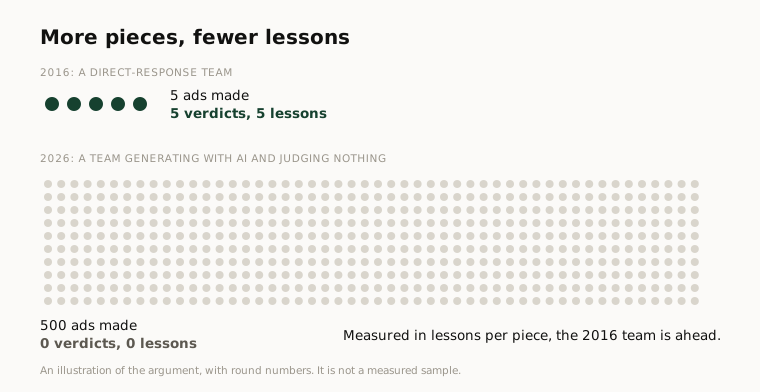
A team that ships five hundred pieces and judges none has learned nothing, however fast it worked. Consider two teams. A direct-response team in 2016 wrote five ads, ran them against each other, read which one brought buyers, and wrote the next five from what it learned. A team in 2026 generates five hundred variations and judges none of them on what buyers did. Measured by what it learns per piece, the 2026 team is behind the 2016 team. It has the bigger engine and it has stopped steering.
The reporting stops before the customer
Most marketing work ends at the click, the chat or the call, so nobody sees which piece made money. At Ivanooo, we counted 156 live Meta ads running in the UAE. Of the 115 that showed a destination, 66 sent the click into a chat or a phone call. On those ads the platform's reporting stops at the start of the conversation, which is exactly where the sale happens. Without a loop that brings the outcome back, the team keeps optimising for the part it can see.
The numbers from real accounts
The numbers from real accounts show large teams with large budgets producing volume and very little variety. We read 90 days of Meta ads from one of the largest property developers in Dubai. In the Ad Library it looks enormous: thousands of ads. Opened one by one, most are the same ad copied across markets and ad sets.
We measured this We counted 43 distinct headlines in 90 days, about three a week. Ninety-eight of its 103 ad texts open with the payment plan. One design ran for four projects, and the offer line changed on all four on the same day. Every ad was in English, for buyers who pay in euros, pounds, rupees and dirhams.
Compare that with how the top of the market works. In our growth playbook, drawn from Motion's 2026 creative benchmarks across 578,750 creatives and 6,015 advertisers, the top quarter of advertisers spending over $1 million a month on Meta launch about 55 new creatives a week and find about 2.7 times as many winning ads a month (10.4 against 3.9). That is a link between volume and winners, not proof that one causes the other. Winning ads are rare, so the number of genuinely new ideas tested each week decides how many winners a team finds. A copy of the same ad gives the platform nothing new to learn from.
We went through 124 dental clinics in Dubai and kept the 38 that were independent, rated 4.5 stars or higher with more than 100 reviews, and had a website we could read. Twenty-one of those 38 had run Google ads at some point. The money was going out. The question is who in each clinic checks whether a given ad brought a patient. In most small clinics that person is the owner, at night, after the last appointment. None of these businesses is short of AI. Each is short of the loop.
An AI agent is more than a writer
An AI agent is a system that can read, remember, calculate, check and decide, and keep doing all five while the team sleeps. A model that writes copy uses one of those abilities. Marketing has hired the most capable worker in its history and given it a typewriter.
An agent can read every ad a category ran last quarter and count what repeats. It can remember every decision the team made and what happened after each one. It can calculate which of fifty candidate moves has the best odds for the money. It can check a draft against the brand's facts and rules before a person ever sees it. It can decide, inside limits a person set, to stop the ad that is losing and put the budget behind the one that is winning.
The shift that matters is from making pieces to running a process: memory, calculation, checking and decision, joined into one loop. A team that uses agents only to write has adopted the cheapest part of the machine and left the valuable part switched off.
Every channel stopped one step short
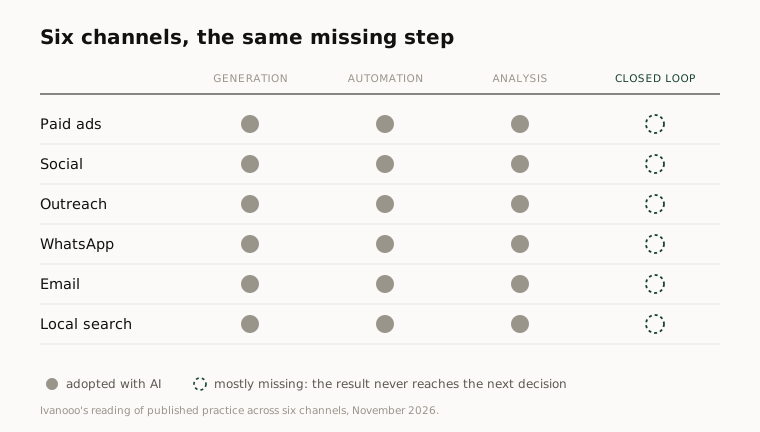
Every major marketing channel took the same three steps with AI and stopped before the fourth. The first step was generation: AI writes the ad, the post, the email. The second was automation: the platform or a tool schedules, targets and sends. The third was analysis: a dashboard reports what happened. The fourth step, the closed loop, takes the result back into the next decision, and it is missing almost everywhere.
How six channels adopted AI, and the step each one skipped
| Channel | 1. Generation | 2. Automation | 3. Analysis | 4. The closed loop, mostly missing |
|---|---|---|---|---|
| Paid ads | AI-made creative | Advantage+, Performance Max | Platform dashboards | Each idea judged on bookings; next week's ads start from the verdict |
| Social | AI posts and video | Scheduling and repurposing | Reach and engagement | Read which post brought a buyer, and make the next one from it |
| Outreach | AI-written email | Sequences and AI SDRs | Open and reply rates | Learn why replies came, and change the list and the message |
| AI replies | Chatbots | Conversation counts | The outcome of each chat goes back to the ad that started it | |
| AI copy | Automated flows | Open rates, now unreliable | Each flow judged again on revenue, on a set date | |
| Local search | AI review replies | Profile tools | Ranking reports | Read what customers say and what AI assistants say, then act on it |
The pattern is the same in every row. The best advice in each channel already ends in the same place. Paid media guides tell advertisers to send offline sales back to the platform. Outreach guides say to stop a sequence the moment someone replies. Email guides tell teams to audit flows nobody has touched in a year. Each channel has found one piece of the loop on its own. No one has joined them into one method, and no channel's learning reaches the others.
Platform automation deserves its own warning. Advantage+ and Performance Max close a loop, and it is the platform's loop. The learning from your spend sits inside Meta and Google, where your competitors rent the same learning on the same terms. A team that hands its whole loop to the platform has bought a strong engine with the controls in someone else's cockpit.
There is an honest gap here. We found no independent study that measures how many marketing teams run a closed loop. The closest figure comes from BCG's 2026 survey of 300 CMOs10: 96% said AI is transforming their whole marketing function, and 8% were running campaigns with multiple autonomous agents. The distance between those two numbers is the distance this paper is about.
What is a Growth Factory?
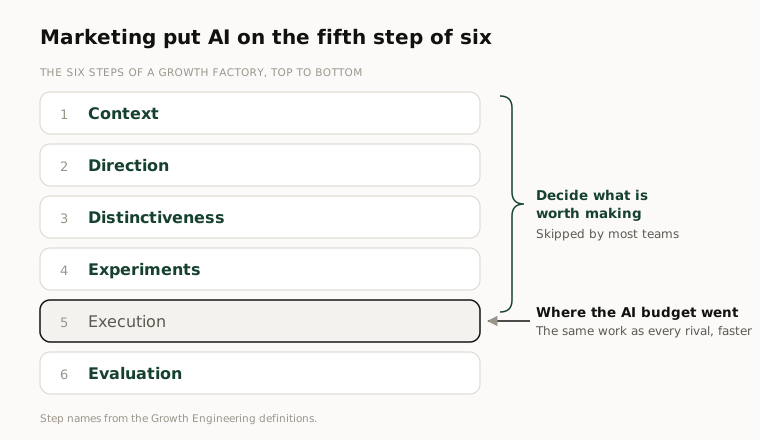
A Growth Factory is a marketing system built as one loop: it finds the opportunities, does the work, learns from customers and improves, then starts again. It runs on six steps, and each step has one job. These are the definitions we hold ourselves to, quoted from our own framework.
- Context. One living record of the business that every agent reads before it writes, decides or spends: the goal and the number, buyers' questions, provable claims with proof, competitors, every decision and what happened.
- Direction. A person's direction on the machine's work, macro and micro: the position it works from, and the moves they make on what it produces, piece by piece, towards the growth goal.
- Distinctiveness. You don't sound like everyone else: what is yours, measured against the machine's average and your category's, and placed where AI reads.
- Experiments. Choose the few moves worth making, prove them, keep what wins.
- Execution. The work done across every channel, on whichever models are best; deliberately the least special part; measured by the level.
- Evaluation. Every other step says what should be true. Evaluation proves whether it was.
Execution is the step marketing has spent its AI budget on. It is the fifth of six. A team that starts there makes the same thing as every other team, only faster.
What sits inside the factory
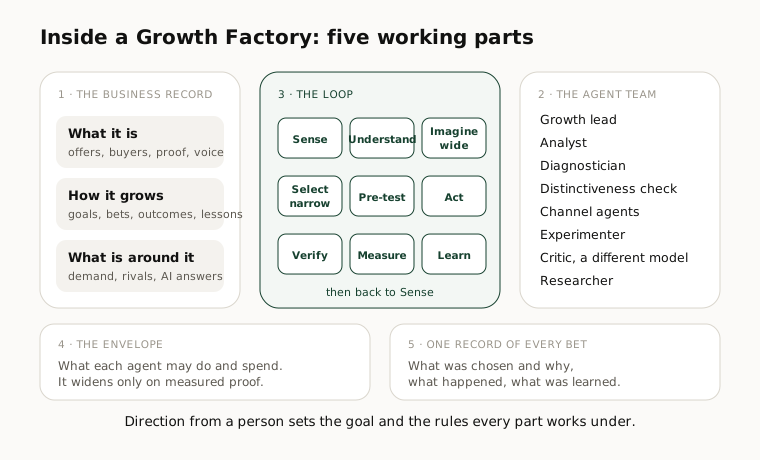
A Growth Factory has five working parts. The first is a business record in three layers: what the business is (offers, prices, buyers, proof, voice), how its growth is believed to happen (goals, bets, outcomes, lessons), and what is true around it (category demand, what competitors are running, what AI assistants say about the category).
The second is an agent team, where each agent has one job and its own checks. A lead holds the goal and the week's bets. An analyst keeps the record true. A diagnostician compares explanations for what is holding growth back. A distinctiveness check reads every asset against the machine's average and the category's.
Around them sit agents for each channel, an experimenter that turns a chosen bet into a fair test, a critic built on a different model that checks claims before anything goes out, and a researcher that answers the question that would change a decision.
The third is the loop itself: sense, understand, imagine wide, select narrow, pre-test, act, verify, measure, learn. The fourth is an envelope for every agent: what it may do, how much it may spend, how many times, and how reversible each action must be. An envelope widens only when an agent's measured reliability earns it, and only with a person's approval.
The fifth is one record of every bet: what was chosen, why, what happened and what was learned. That record is what makes the next decision better than the last.
Generate wide, select narrow
The single idea that separates a factory from a content machine is where the value sits. Generation is free, so a factory imagines fifty or two hundred candidate moves for almost nothing. The value moves to choosing: ranking those candidates by expected return, uncertainty, cost, reversibility, distinctiveness and how many competitors are already running the same move. "Do nothing" and "research first" are always on the list.
What a Growth Factory cannot do
A Growth Factory cannot promise growth, and any system that promises growth is selling something else. Growth is a bet placed in a market that answers back, and some of its causes sit outside marketing altogether: the product, the price, the economy, a competitor's launch. What a factory can do is raise the odds of each bet, prove which moves worked, and stop the ones that did not before they cost more. That is what the Wrights built. Control does not guarantee the flight. It is what makes flight possible at all.
The five levels of AI-native marketing
The five levels measure one thing: how much of a business's marketing runs without a person stepping in, safely.
- Level 1, Assisted. AI helps with tasks. The work itself is still made by people.
- Level 2, Delegated. AI makes the work. Each piece waits for a person's check before it goes out.
- Level 3, Self-checking. AI makes the work and checks it against your rules. It goes out without a person checking each piece.
- Level 4, Self-optimising. AI measures the results and improves, scales or stops what is running.
- Level 5, Growth Factory. A loop that runs itself: AI finds the opportunities, does the work, learns from customers and improves, then starts again.
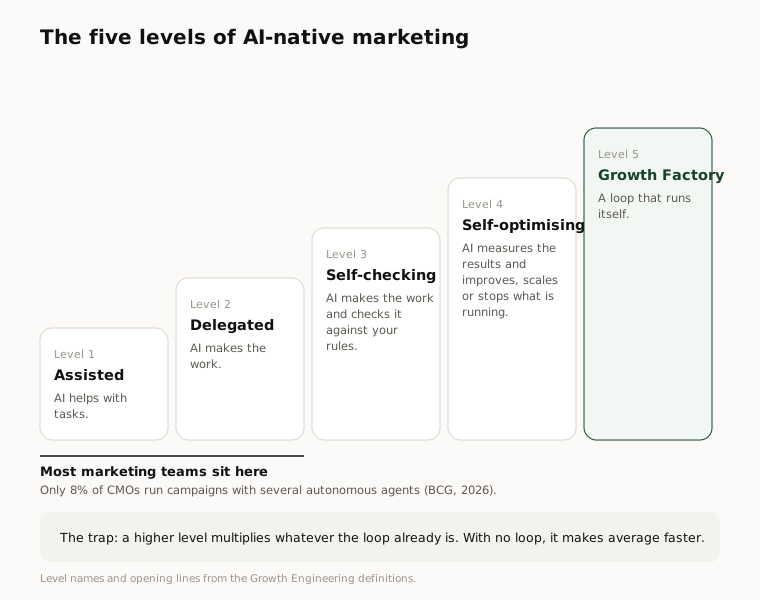
Most marketing teams sit at Level 1 or Level 2. The market's own numbers point there. In a survey of 350 marketing decision-makers by Contentful and The Atlantic's Re:think11, 21% required a person's approval before any agent action, and the same report found governance, measurement and ownership inconsistent across teams. BCG's10 8% running multiple autonomous agents is the ceiling, and running agents is not the same as closing a loop.
The levels carry a trap. A higher level multiplies whatever the loop already is. A team that only generates and moves from Level 2 to Level 4 has automated the production of average work. Speed on a team with no loop is Langley with a bigger engine.
What is a Growth Factory builder?
A Growth Factory builder is the marketer who builds and directs the loop: who writes the goal, the rules, the bar and the bet, and judges what came back. This is the job every marketer is now paid for, whatever the title says. We have called the discipline behind it Growth Engineering. The role inside it, the one a marketer can recognise on a Monday morning, is the builder of the factory.
It needs no code
A Growth Factory builder does not need to write software. The builder needs precision: a written number, a written standard, a written bar a piece of work must clear before it ships, and a written expectation before a bet goes live. Precision is a habit. It can be learned by any marketer who is willing to write down what they expect and then look at what happened.
It needs direction, macro and micro
The skill that matters is direction, and it has two halves. The macro half is the position the machine works from: who the business is for, what it will and will not say, what it charges, what it refuses to sound like. The micro half is the moves a person makes on each thing the machine produces, piece by piece, towards the growth goal.
Direction is more than prompting. A prompt asks. Direction shapes, rejects, corrects and decides. A builder's direction leaves marks on the work that can be seen afterwards: how a piece was framed, which option was chosen and which were dropped, what limit was set, what substance was added that the machine did not have, what was cut on taste, what was corrected. Each mark can be shown as a pair: what the machine wrote, and what shipped.
A marketer whose direction leaves no marks is approving, and approval is the thinnest form of direction there is. Handing the whole judgement to the machine, one approval at a time, is what we call cognitive surrender, and it is how a team with a strong engine ends up with nobody steering.
What a builder checks every week
Take one campaign from last month and answer five questions about it.
- Did the idea come from something a buyer said?
- Did anybody write the expected result before it went live?
- Can you see which leads became paying customers?
- Did somebody decide, on a fixed day, to continue it or stop it?
- Did the next campaign start from that decision?
AI made the making fast. These five things are still done by hand, or they are skipped. A team that answers no to most of them is making more every week and learning very little from any of it. A Growth Factory is these five things connected in one system and running every day, with agents doing the work and a marketer giving the direction.
Why do marketers resist the closed loop?
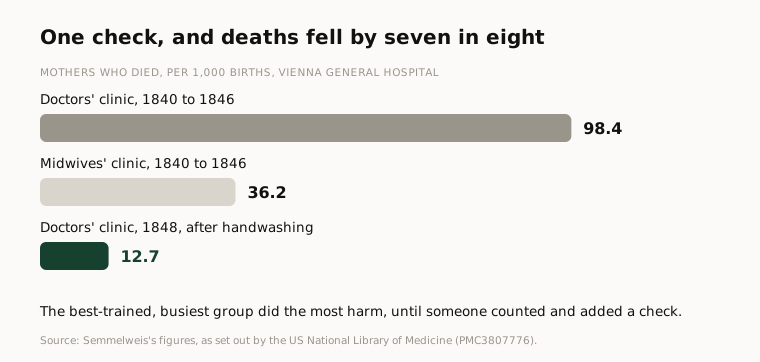
Marketers resist the closed loop for the same reason doctors resisted handwashing: admitting the check means admitting that the busy work did harm. In Vienna in the 1840s, the General Hospital ran two maternity clinics side by side. Doctors and medical students staffed the first. Midwives staffed the second. Between 1840 and 1846 the doctors' clinic lost 98.4 mothers in every 1,000 births. The midwives' clinic lost 36.2, according to the history set out by the US National Library of Medicine12. The best-trained, busiest group was killing nearly three times as many mothers.
Ignaz Semmelweis counted the deaths and looked for the difference. The doctors came to the delivery ward straight from performing autopsies. In 1847 he had the medical students wash their hands in chloride of lime before entering the maternity ward. In 1848 the doctors' clinic lost 12.7 mothers per 1,000 births, level with the midwives' 13.3.
The profession rejected him. Semmelweis had few supporters in his lifetime, and the medical historians who revived his name decades later described the opposition of his contemporaries as implacable. Accepting the result meant accepting that their own skill and diligence had been carrying death from one room to the next.
Marketing is in a version of that room now. The teams with the most tools and the most output are carrying something from piece to piece that none of them is measuring: the machine's average, the category's sameness, the unexamined guess. The fix is as plain as soap. Judge every piece on what buyers did, and let the verdict shape the next one. The resistance is just as plain. A team that starts measuring will find out how much of last year's work did nothing, and some of it did harm.
Five worries marketers name, and a builder's answer to each
Marketers name the same five worries about AI across the 2026 surveys, and each one has a builder's answer.
"AI will take my job"
The data says the making roles are shrinking first. Content marketer roles fell 11% and SEO specialist roles 15% in a single year, in the AMA's 2026 career report7, while senior and strategic roles held steady. A Growth Factory builder moves to the two jobs the machine cannot hold for a business: the direction it works from, and the verdict on whether it worked. The marketer at risk is the one who uses AI only to generate.
"Everything sounds generic"
Generic output is the top complaint about AI work in several 2026 surveys, and the research on creative homogeneity explains why it will not fix itself. We traced the pattern across a whole market in the sea of sameness. A builder sets a distinctiveness bar for every piece, measured against the machine's average and the category's, and refuses work that falls under it before it reaches a buyer.
"I can't trust the data or the output"
Epsilon's 2026 benchmark study13 found that 45% of marketers name data quality as their top AI challenge. A builder writes the facts once, in one record every agent reads before it writes or spends, so the machine works from the business's own truth and not from a fresh guess each time.
"Nobody taught me how to do this"
Most marketers learned AI by themselves, one prompt at a time. Direction is learned the same way it is used: on every piece, by leaving a mark and checking afterwards whether the mark made the work better. A team can start tomorrow with the five weekly questions.
"I can't prove the return"
Belief in AI runs ahead of proof. Gartner found 70% of CMOs call AI leadership a key goal, while MIT's research found 95% of organisations seeing no business return. A builder writes the expected result before a bet goes live, sets the date it will be judged, and records the verdict, whether right, wrong or not enough evidence. Return becomes something a team can show instead of something it hopes for.
What should a marketer do this month?
A marketer should start by answering the five weekly questions for one real campaign, honestly, and writing the answers down. Then score the stack. The Stack Score takes about nine minutes and names the step of the loop that holds a team back, because a loop is only as strong as its weakest step.
After that, pick one channel and close one loop. Write the expected result of next month's campaign before it launches. Set the day it will be judged. Bring back the outcome from past the click, the chat or the call. Make the campaign after that one start from the verdict. One closed loop teaches a team more than a quarter of open ones.
The method behind all of this is written out on the Growth Engineering page, step by step. Our own work on one channel, AI in paid advertising and the loop around the auction, shows the same argument applied to Meta and Google ads.
The loop decides what to make. Being found decides whether anyone sees it, and The Distribution Gap is our paper on that half of the work.
The choice in front of every marketer
Langley was not stupid. He ran the Smithsonian, and he had the government's money and the strongest engine of anyone trying to fly. He believed that if the power was great enough, the rest would follow. Two mechanics with a bicycle shop proved him wrong in nine days, because they had built the thing he never thought to build: a way to feel what the machine was doing and correct it in the air.
Marketing now has its 53-horsepower engine. Every team has one, and every team's engine is the same. What will separate the teams that grow from the teams that go into the river is whether they build the controls. Every marketer can become a Growth Factory builder. The ones who do will spend the next few years learning from every piece they ship. The ones who do not will spend them making more.
Questions
What is AI-native marketing?
What is a Growth Factory builder?
What is closed-loop marketing?
Will AI replace marketers?
Why is AI marketing not delivering ROI?
Do I need technical skills to build a Growth Factory?
About the author
Firoz Azees, founder of Ivanooo. Fifteen years running growth for companies in Dubai, Singapore, London and Silicon Valley. Runs a 62-question AI answer panel and publishes what it measures.
Sources
- Smithsonian's record of the Langley Aerodrome (si.edu) · primary source
- a 1901 talk to the Western Society of Engineers (invention.psychology.msstate.edu) · primary source
- HubSpot's AI trends report (blog.hubspot.com)
- Gartner's 2026 CMO Spend Survey (gartner.com)
- The GenAI Divide (virtualizationreview.com)
- Fortune's coverage of the report (fortune.com)
- American Marketing Association's 2026 career report (ama.org)
- the 4A's (aaaa.org)
- We're Different, We're the Same: Creative Homogeneity Across LLMs (arxiv.org) · primary source
- BCG's 2026 survey of 300 CMOs (bcg.com)
- survey of 350 marketing decision-makers by Contentful and The Atlantic's Re:think (research.agilebrandguide.com)
- US National Library of Medicine (pmc.ncbi.nlm.nih.gov) · primary source
- Epsilon's 2026 benchmark study (epsilon.com)
First published 13 Nov 2026.
Find out if AI can tell you apart.
A free read of how interchangeable your pages are with your competitors', with the answers captured. Get your free growth audit