The Distribution Gap: Anyone Can Make Things Now. Few Know How to Be Found.
For four thousand years someone had to say yes before a maker could reach a buyer. Today nobody does, and the share of makers who get found has barely moved.
By Firoz Azees · Published · 28 min read
How do you get discovered online when anyone can make anything? The chance to be found has never been bigger, and the number of creators who are found rises every year. Discovery itself still follows a power law. The distribution gap is the space between having that chance and knowing how each channel decides who it shows.
This paper follows the gap from the merchant roads of the Bronze Age to the AI answer. Every number in it was checked against its source on 12 November 2026.
- About 13 million artists uploaded music to Spotify in 2025, and 81,100 of them generated $10,000 or more in royalties. That is about 0.6%, close to the share in 2023, taken from a larger crowd every year.
- For most of history a road-holder, a crown charter, a printing licence or a record label said yes before a buyer could choose. Today the audience and the algorithm choose.
- The power law needs no villain. Limited attention and success that feeds on success produce it on their own: on Twitter in 2014 the top 1% of users held 60% of all followers.
- AI makes making close to free, so the crowd at every channel grows faster than attention. Knowing how each channel decides, and making enough honest attempts at it, is the skill that is left.
What is the distribution gap?
The distribution gap is the difference between the chance to be found and the act of being found. Spotify's own figures show both sides in one report.
In 2025 about 13 million artists uploaded at least one track to Spotify, according to the Loud & Clear report Spotify published on 11 March 20261. Of those, 81,100 generated $10,000 or more in royalties, or 6 in every 1,000 artists who tried.
The same count was 52,600 in 2021. The number of artists who crossed the $10,000 line grew by 54% in four years, while the share of uploaders who crossed it stayed close to 0.6%. Both numbers are true at once, and most reporting picks only one of them.
Figure 1 puts three years on one scale. The grey bar is every artist who uploaded music that year. The green sliver is every artist whose music generated $10,000 or more. The bar grows, the sliver grows with it, and the sliver stays a sliver: 0.66% in 2023, 0.59% in 2024 and 0.62% in 2025.
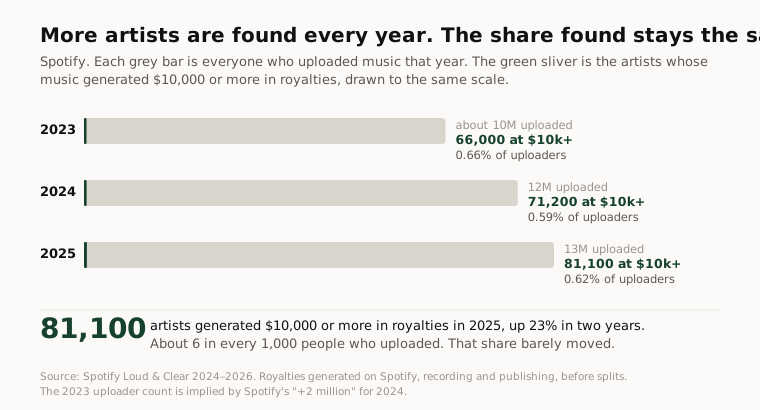
Spotify counts royalties generated on the platform, recording and publishing together, before they are split between labels, distributors, songwriters and artists. The $10,000 line is a royalty line, so it measures being found well enough to be paid, which is close to what this paper means by discovery.
The gap has two common readings. The gloomy reading says the platforms are rigged and small makers cannot win. The cheerful reading says anyone can go viral. The figures support neither one. More makers are found every year, and almost all makers are not.
Before the internet, someone had to say yes first
Before the internet, someone had to say yes before a maker could reach a buyer. The cost of making things fell many times over four thousand years. The permission to reach buyers stayed with a small number of holders, and each new medium created a new holder.
Around 1900 BCE, merchant families from the city of Assur ran a trade route to Kanesh in central Anatolia. The historian Cécile Michel's work on their letters shows tin sold in Anatolia at about twice its purchase price, and textiles at up to three times. Those figures are the top of the range, and the margin went to the families who held the road and its donkey caravans.
The makers of the cloth did not meet its buyers, and reaching a buyer two months' walk away required a family firm, a caravan and the right to trade in a foreign city. Distribution belonged to whoever held the route.
In medieval England a market existed because the crown granted it. The 13th-century legal writer Bracton, as William Blackstone read him in the 1760s, treated a new market within a third of a twenty-mile day's journey of an old one, about 6⅔ miles, as a nuisance to the old market.
Legal historians doubt the rule was enforced as written, but the principle behind it was plain: the law protected the market that already held the buyers, and a newcomer needed a charter to compete.
The Champagne fairs of the 12th and 13th centuries show the other side of the same history. Merchants from Italy, Flanders and beyond met at a fixed cycle of fairs in the towns of Champagne, and the fairs grew because someone enforced trust between strangers.
Paul Milgrom, Douglass North and Barry Weingast argued in 1990 that private merchant judges did this work. Jeremy Edwards and Sheilagh Ogilvie argued in 2012 that public authorities, the counts of Champagne first among them, did it, and that the fairs rose and fell with those authorities' policies. Either way, a channel opened to outsiders when a holder chose to keep it open and to enforce its rules for every trader. It closed again when that holder changed course.
The printing press is the closest match to AI in this history. Jeremiah Dittmar's research finds that book prices fell by about two-thirds between 1450 and 1500. Making a book became cheap within two generations.
Permission did not follow the price. From the Stationers' Company charter of 4 May 1557 until the Licensing Act lapsed in 1695, a London guild decided who could print in England. A book could cost less to make than ever and still need a licence to exist. The Statute of Anne in 1710 moved the right toward authors.
The English East India Company received its charter on 31 December 1600, and the Dutch East India Company (the VOC) on 20 March 1602. Each held its country's monopoly on trade with Asia. Distribution was a legal right owned by a company and backed by ships and soldiers, a long way from a buyer choosing freely.
In the 20th century the holders changed form. A supermarket chain decided which products reached its shelves, and a 2003 US Federal Trade Commission study of nine grocery chains found suppliers paying them for shelf space in five categories, from fresh bread to ice cream. A small number of record labels decided which songs reached radio and record shops. Each of these holders said yes or no before a single buyer saw the product, and the buyer chose among what the holder had already chosen.
The first broad opening came by post. US Rural Free Delivery began as an experiment in 1896 and became permanent on 1 July 1902. Farm families could receive a mail-order catalogue at home, and a seller in Chicago could reach them. It was still one company's catalogue, and the buyer chose from what it held.
The internet removed the first yes. A maker no longer needs a charter, a licence, a label or a shelf to publish. The audience chooses first, through search results, feeds and recommendations. This is the largest change in who may try to reach a buyer since the market charter, and this paper counts it as real progress. What the internet did not change is the order in which attention is handed out, and the rest of this paper is about that order.
The chance to be found, channel by channel
Every major channel now publishes some count of how many makers take part and how many cross a line that matters. Read together, the counts show the same two facts on each channel. The number of makers who are found is rising. Those makers are a small share of the makers who try.
Spotify's reports show artists whose music generated $1 million or more numbering 860 in 2020 and more than 1,500 in 2025. Spotify's 2022 report showed that 29% of the artists above $10,000 in 2021 distributed their own music with no label: 15,140 of 52,600. In the 1990s those artists would have needed a label's yes to reach a record shop.
YouTube's chief executive Neal Mohan wrote in his 2024 letter2 that more than 3 million channels were in the YouTube Partner Program, up from more than 2 million in August 2021. YouTube says it paid more than $70 billion to creators, artists and media companies from 2020 to 2023. A channel in the Partner Program earns from advertising. A channel outside it earns nothing from YouTube directly.
Substack announced 5 million paid subscriptions in March 2025, up from 1 million in November 2021. A paid subscription is a reader paying a writer directly, with no publisher in between. Substack counts subscriptions, so one reader who pays three writers counts three times.
Amazon said in May 2022 that more than 2,000 self-published Kindle authors had already passed $100,000 in royalties that year. Before ebooks and print-on-demand, a self-published author had almost no route to a bookshop shelf.
Patreon's chief executive Jack Conte told Axios in August 2025 that creators had received more than $10 billion through Patreon since 2013, at a rate of about $2 billion a year. Each of those dollars came from a member paying a creator directly.
Etsy's annual reports show a channel can shrink as well as grow. The Etsy marketplace had 7.0 million active sellers in 2023 and 5.6 million in 2024. An open channel lets makers in and lets them leave when sales do not come.
Amazon reported that more than 75,000 independent sellers passed $1 million in sales in its store in 2025, up 36% on 2024. Amazon does not define this count the same way across years, so this paper uses the most recent year only.
The open web is the base layer under all of these channels. Ahrefs studied about 14 billion pages3 in its index and found that 96.55% of them get no traffic from Google at all.
The same pattern holds on each channel. A large number of makers take part, and a growing number cross a line that pays. The share who cross stays small. For the first time in the history above, the cost of trying is close to zero, and the limit on being found is attention itself.
Why does being found still follow a power law?
A power law is a distribution where a small number of items take most of the total and a long tail of items takes the rest. Being found follows one on every channel measured above. Nobody has to rig it. Five mechanisms produce it on their own.
Attention is limited
Herbert Simon, the economist who later won the Nobel prize, put the limit in one sentence in 1971:
"Hence a wealth of information creates a poverty of attention." (Herbert Simon, "Designing Organizations for an Information-Rich World", 1971)
Attention is the one input that does not grow when making gets cheaper. Lilian Weng and colleagues showed in Scientific Reports in 2012 that limited attention alone produces a few very popular items and a long tail. Their model was checked against Twitter data and assumed no difference in quality between items.
Success feeds success
Robert Merton named this the Matthew effect in 1968: recognition flows to those already recognised. Derek de Solla Price measured the same effect in scientific citations. Albert-László Barabási and Réka Albert showed in Science in 1999 that a network grows into a power law when new links attach to the nodes that already have the most links.
On a social feed this works plainly. A post from an account with many followers reaches more new readers, some of those readers follow, and the next post starts from a larger base.
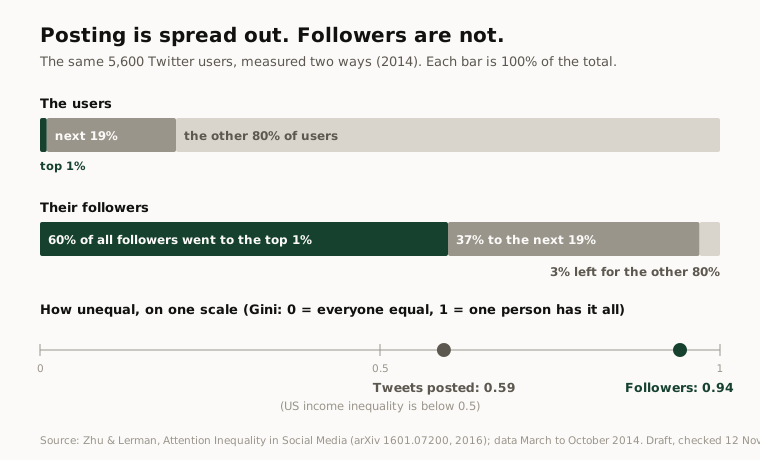
Linhong Zhu and Kristina Lerman measured the result in 20144 on 5,600 randomly chosen Twitter users and the accounts they followed. The top 1% of users held 60% of all followers, and the top 20% held 97%. Posting was spread far more evenly: on the Gini scale, where 0 means equal and 1 means one account holds everything, tweets posted scored 0.59 and followers scored 0.94. Effort was shared out, and attention was concentrated.
Small differences become large differences
Sherwin Rosen explained in the American Economic Review in 1981 why a slightly better performer can earn many times what a slightly worse one earns. When one recording can serve every listener at almost no extra cost, listeners choose the one they rate best, and a small difference in quality turns into a large difference in income.
Moshe Adler added in 1985 that stardom can arise among performers of equal talent. Listeners enjoy what other listeners already know, so knowing the popular choice has value in itself.
Other listeners' choices make it unpredictable
Matthew Salganik, Peter Dodds and Duncan Watts ran the clearest test of this in Science in 20065. They gave 14,341 participants 48 unknown songs and split them into eight separate worlds where listeners could see what others in their world had downloaded, plus one world where they could not.
Seeing other listeners' choices made success more unequal and harder to predict. The same song could finish near the top in one world and far lower in another. The best songs rarely did badly, and the worst rarely did well. Between those ends, the first downloads decided a great deal.
Salganik and Watts followed up in 2008 by showing listeners false popularity. Most songs experienced self-fulfilling prophecies, and the best songs still recovered part of their ground over time. Quality matters at the edges, and the first break depends heavily on luck.
Recommendations repeat what already sold
Daniel Fleder and Kartik Hosanagar showed in Management Science in 2009 that common recommender designs can reduce the total diversity of what is sold, even while each buyer sees new items. A system that recommends what sold well yesterday sends more buyers to it today.
Both ends can grow at once
Erik Brynjolfsson, Yu Hu and Michael Smith found that niche books, those outside the top 100,000 by sales rank, made up 36.7% of Amazon's book sales in 2008. Anita Elberse reported in the Harvard Business Review in 2008 that the top 10% of titles on the music service Rhapsody took 78% of plays.
The two findings do not contradict each other. A market that grows can make both the head and the tail larger. Joel Waldfogel called the result of digitisation a golden age for buyers, in the Journal of Economic Perspectives in 2017, with more good products than before and many of them from outside the old holders of permission.
What the mechanisms mean for a maker
The five mechanisms point to the same three facts for anyone trying to be found. The first signal matters out of proportion, because every later reader sees what the first readers chose. Small advantages compound, so a maker who starts slightly ahead on a channel stays ahead unless something resets the order. And the outcome of any single attempt carries a large share of luck, which the MusicLab worlds showed directly.
None of these facts tells a maker to stop. Each tells a maker where effort pays: in the first readers of a piece, in the early signals a channel reads, and in the number of attempts made.
The power law is the shape free choice takes when attention is limited. It cannot be voted away. A maker can learn how it works and move along it. An earlier essay on how we inherited nature's power law, then broke it6 looks at why the top of the curve stops resetting once it forms.
What does AI change for discovery?
AI makes making close to free and leaves attention the same size. The result is a larger crowd at every channel, more of it alike, and channels that send fewer visitors onward.
The flood
Graphite, a search company, found that about half of new English-language web articles were primarily AI-generated in the first quarter of 2026: 49.9%, averaged across three detection tools.
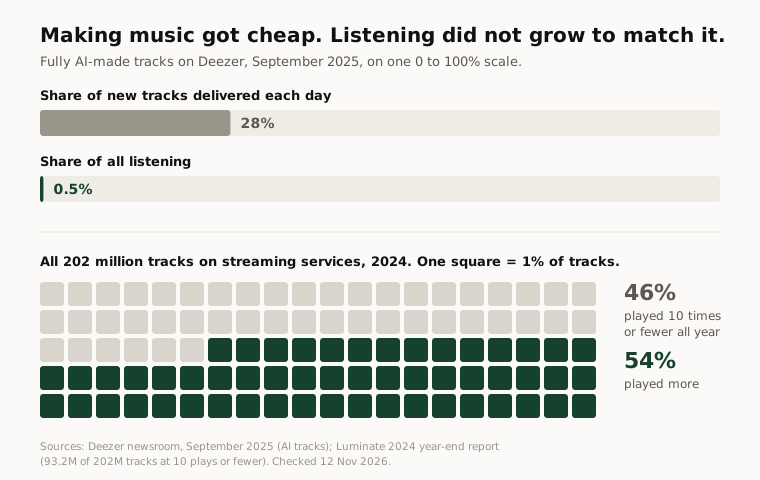
Deezer, the music streaming service, reported in September 2025 that it received more than 30,000 fully AI-generated tracks a day. That was over 28% of all music delivered to it, and those tracks drew about 0.5% of all streams. Deezer judged up to 70% of the streams they did draw to be fraudulent.
Luminate's 2024 year-end report counted about 202 million tracks on streaming services. Of those, 93.2 million, or 46%, were played 10 times or fewer in the whole year.
More of the same
Anil Doshi and Oliver Hauser tested AI help on short-story writers in Science Advances in 20247. Writers given AI ideas wrote stories that readers rated more creative, and the stories became more similar to each other. Each writer gained, and the group produced a narrower range of work.
On a channel that rewards being distinct, a crowd using the same tools makes standing apart harder for each member of it. Ivanooo states the wider shift in one line: execution is free, growth isn't, and sameness is the price of free execution. Distinctiveness, work that differs from the crowd around it, is what gives a channel a reason to show a maker at all.
The free channels narrow
The channels that once sent strangers to a maker at no cost have narrowed too. SparkToro, working with the Datos panel, found that 58.5% of US Google searches in 2024 ended without a click to any website. A 2026 SparkToro study on a different panel put the figure at 68%. The two panels are not comparable, so the second figure stands on its own and does not show a trend.
The Pew Research Center studied 68,879 searches8 by 900 US adults in March 2025. Users clicked a traditional result 8% of the time when an AI summary appeared, against 15% when one did not. Ahrefs found that AI Overviews correlate with a 34.5% lower click-through rate for the top-ranking page in April 2025, and a 58% lower rate in its December 2025 data.
Facebook said in 2012 that the average page reached about 16% of its fans with a post. Socialinsider measured Facebook's reach rate at 1.25% in August 2026, on a different method.
In AI answers the concentration is sharper still. Kevin Indig's analysis of ChatGPT citations found that in product-comparison topics the top 10 domains take 46% of citations, and that 15% of the pages ChatGPT retrieves end up cited.
Spotify removed more than 75 million spam tracks in the 12 months to September 2025. The platforms are now built to resist volume, so publishing more of the same stops working as an edge once every maker can publish more.
AI widens the gap in share without closing the channel. A maker who is distinct, and who knows how the channel decides, still gets through, and the number who do keeps rising.
Luck, effort and knowing
The evidence above gives luck a large role, and it also shows where effort and knowledge change the odds. Roberta Sinatra and colleagues studied the publication records of 2,887 physicists, and of scientists in other fields, in Science in 20169. They found that a career's highest-impact paper is equally likely to be the first, the tenth or the last. They also found a stable ability factor, which they call Q, that differs from one scientist to the next. Ability sets the odds of each attempt. The timing of the hit is random.
If any attempt can be the hit, the number of honest attempts decides how many chances a maker gets. Five attempts give five draws, and thirty attempts give thirty, at the same odds each time.
Lu Liu and colleagues studied about 30,000 careers of artists, film directors and scientists in Nature in 2018. They found hot streaks across all three kinds of career: periods of higher impact with no rise in output. Their 2021 follow-up in Nature Communications found that hot streaks are associated with a period of exploration followed by a period of focused work. The maker who stays in the game long enough is the one in a position to catch the streak.
Kevin Kelly argued in 2008 that a creator needs about 1,000 true fans, each bringing in about $100 of profit a year, to make a living. The arithmetic holds. The base rate is sober: by one estimate from Goldman Sachs in 2023, about 4% of some 50 million creators are professionals earning more than $100,000 a year.
Paid media made up 30.6% of marketing budgets in Gartner's 2025 survey of 402 marketing leaders. A small maker cannot outbid a large one on a paid channel, and even inside the auction the gain comes from the loop around it, as Ivanooo's piece on how AI in paid advertising works inside the auction sets out. Knowledge and effort win on the channels money cannot simply buy: answering a question best, earning a first signal, being named by others and owning a list of readers.
Knowing decides whether each attempt is aimed at a channel that can open for it. No study yet measures this directly, because the capability has no name in the research. The next section names it, and says plainly that its edge is argued from the evidence above, not yet measured.
What is distribution literacy?
Distribution literacy is knowing how a channel decides what it shows, where you stand in it today, and how to turn each attempt's result into a better next attempt.
The term does not appear in the research literature. The nearest field is algorithmic literacy. Those studies teach users why a feed shows them something. UNESCO's 2024 policy brief on media and information literacy said AI literacy, which builds on data and algorithmic literacy, is still in its infancy. None of it teaches a maker how to be found.
Distribution literacy today is passed on informally: through a founder parent, a first job at an agency or a friend who runs a channel. Makers without those links learn it by trial and error. This is the reason to teach it as a basic skill, the way reading a contract is taught, and not as a marketing specialism.
Five channels and what decides who they show
| Channel | Examples | What decides who is shown | The question to ask today |
|---|---|---|---|
| Search | Google, Bing | The page that answers a question best, and that other sites trust | Which one question do I answer better than the pages ranking now? |
| Social feeds | Instagram, LinkedIn, TikTok | How the first viewers of a post react to it | Who are the first 50 viewers who will react, and why would they? |
| Marketplaces | Amazon, Etsy, app stores | Reviews, and how fast the first sales come | Where will my first 100 buyers and their reviews come from? |
| AI answers | ChatGPT, Gemini, Perplexity | What other sites say about you | Where am I named, outside my own website? |
| Your own list | Email, WhatsApp, a community | You decide | How many readers can I reach today without a platform? |
Search rewards the clearest answer to one question. A page that tries to answer every question competes with pages that answer one of them well. Ahrefs' 96.55% figure is the cost of publishing pages that answer no question better than the pages already ranking.
Social feeds decide reach from the first reactions. A post shown to a small first group travels further when that group responds, and stops when it does not. A maker who knows this plans who sees a post first.
Marketplaces rank on reviews and early sales speed. A new listing with no reviews and no sales starts below listings that have both, so the first buyers have to come from somewhere other than the marketplace's own search: an existing list, a community, a recommendation.
AI answers draw on third-party sources. AirOps found in a 2025 study of more than 500 queries that about 85% of brand mentions in AI answers come from sources other than the brand's own site. A maker named on the sites an AI reads gets mentioned, and a maker named only on their own site does not. Ivanooo's guide for when you are absent from the AI answers sets out the first steps.
Your own list is the one channel a platform cannot narrow. Facebook's page reach fell from about 16% in 2012 to a reach rate of 1.25% in 2026 on Socialinsider's measure. An email list a maker owns did not change in that time.
How to see where you stand today
Distribution literacy starts with a reading of the present. Each channel offers a way to read it, at no cost.
On search, the question is which queries a page already appears for and at what position. Google Search Console shows impressions and position for every query that surfaced a page in the last 16 months. A page with impressions and no clicks is being shown and passed over. A page with no impressions is not in the race for any query at all.
On a social feed, the reading is the first hour. The reactions a post earns from its first viewers decide whether the feed shows it further. A maker who records first-hour reactions across 20 posts learns which kinds of post earn a first signal from their own audience, which no general advice can tell them.
On a marketplace, the reading is a comparison: review count, rating and price against the five listings that rank above yours for the search a buyer types. The gap between your listing and the fifth one is a concrete number of reviews.
On an AI answer, the reading is a test. Ask ChatGPT, Gemini and Perplexity the question your buyer would ask, three times each, and record whether you are named and which sites are cited. The cited sites are where being named would change the answer.
On your own list, the reading is the size of the list and the share who open. A list of 500 readers who open is a channel no algorithm can take away.
Why opening the rails was not enough
Open channels need makers and buyers who know how to use them. India's government-backed Open Network for Digital Commerce saw retail orders fall from about 6.5 million a month in October 2024 to about 4.3 million in April 2025, after its incentives were cut. Mastodon, the open social network, had 734,707 monthly active users in October 2026, against a peak of about 2.6 million in November 2022. In both cases the rails were open, and the missing piece was the knowledge of how to be found on them.
The work of marketing is moving the same way
In Gartner's 2025 survey, 22% of marketing leaders said generative AI lets them rely less on agencies. WPP, one of the largest advertising groups, reported its headcount falling from 108,044 at the end of 2024 to 97,388 in June 2026. Part of that fall reflects a weak market, so the figure proves less than it first appears to. The direction is clear even so: AI made the making cheap, and the work that remains is getting found.
Who needs it
A student with a portfolio, a freelancer, a teacher with a course, a clinic owner, a musician and a small brand each make something and need to be found. Each faces the same five channels. Distribution literacy is the part of their work that AI cannot do for them, because it depends on knowing where they stand today.
It sits beside the two things a maker keeps when execution is free: judgment about what to make, and a distinct voice. Literacy aims the attempt, and distinct work gives the channel a reason to show it. Growth Engineering, the practice Ivanooo teaches, runs the same habit as a loop: read where you stand, choose one move, make it, and send the result back in before the next move.
What can a maker do this week?
The evidence in this paper points to a short set of first moves. None of them needs a budget, and each one is a habit that compounds.
Pick one channel and read where you stand. Use the readings above. A maker spread across five channels with no reading of any of them is guessing on all five.
Name the one question you answer best. Search and AI answers both reward the clearest answer to a specific question. Write that answer before writing anything else.
Plan the first readers. On feeds and marketplaces the first signal decides the rest. Know who will see a piece first and why they would respond.
Be named somewhere you do not own. About 85% of brand mentions in AI answers come from third-party sources, so one honest mention on a site an AI reads is worth more than another page on your own site.
Make more honest attempts, and record each one. Sinatra's finding means the next attempt has the same chance of being the hit as the last. Recording what happened turns each attempt into a better next attempt.
Start a list you own. Every reader who joins an email list or a community is reach that no platform change can remove.
The list is short on purpose, because distribution literacy is a habit of reading, aiming and recording, repeated over many attempts.
The chance and the skill
Spotify's two numbers return at the end. In 2025, 81,100 artists generated $10,000 or more, the largest count yet, and they were about 6 in every 1,000 who tried.
For four thousand years a road-holder, a crown, a guild or a label decided who could try. Today nobody has to say yes first. Who gets found now depends on knowing how each channel decides, and on making enough honest attempts at it.
Questions
What is the distribution gap?
Is it harder to get discovered online today than before the internet?
Is the creator economy zero-sum?
Does AI make it harder to get discovered?
What is distribution literacy?
Why does online success follow a power law?
About the author
Firoz Azees, founder of Ivanooo. Fifteen years running growth for companies in Dubai, Singapore, London and Silicon Valley. Runs a 62-question AI answer panel and publishes what it measures.
Sources
- Loud & Clear report Spotify published on 11 March 2026 (newsroom.spotify.com)
- 2024 letter (blog.youtube)
- Ahrefs studied about 14 billion pages (ahrefs.com)
- measured the result in 2014 (arxiv.org) · primary source
- Science in 2006 (doi.org) · primary source
- how we inherited nature's power law, then broke it (ilanooo.com)
- Science Advances in 2024 (doi.org) · primary source
- Pew Research Center studied 68,879 searches (pewresearch.org)
- Science in 2016 (doi.org) · primary source
First published 13 Nov 2026.
Find out if AI can tell you apart.
A free read of how interchangeable your pages are with your competitors', with the answers captured. Get your free growth audit